Tuesday, June 3, 2014

Deborah Rix


The VOIGHT-KAMPFF* Interview
*Bladerunner
Leon: Do you make up these questions, Mr. Holden, or do they write them down for you?
Mr. Holden: They’re just questions, Leon.
WHAT IS THE FIRST SCIENCE FICTION BOOK YOU REMEMBER READING?
A Canticle for Leibowitz by Walter M. Miller, Jr. I’m sure I read others first, but that’s the one that stuck with me. As it turns out, I wrote along similar themes to Miller, although my faith lies with science while his was in the Church.
WHAT BOOK WOULD YOU LIKE TO READ AGAIN?
Neuromancer, by William Gibson. It changed science fiction for me, completely. There seemed to be an abundance of epic space fantasy at the time I first read it. Other worlds, other species, other times. Neuromancer was ten minutes into the future and it was exciting. I once stood in a very long line at my favourite SF bookstore to get Gibson to sign my copy. I was the only girl.
WHAT BOOKS HAVE INFLUENCED YOUR WRITING?
From a technical perspective there are two: How Not To Write A Novel, by Howard Mittelmark and Sandra Newman, and Elements of Fiction Writing by Orson Scott Card. There are others, but those are the two with all the dog ears and sticky notes.
LAPTOP OR DESKTOP FOR WRITING?
Laptop. I like to move around the house, depending upon my mood. But, in the near future, I’m hoping to get an actual writing space that is ALL mine. With a door.
DO YOU HAVE ANOTHER JOB BESIDES AUTHOR?
I have a general store/cafĂ© called The Lucky Penny, it’s a neighbourhood joint on Trinity-Bellwoods Park in Toronto. It was a long and tortuous process to redevelop the property and open the shop, and ultimately was the catalyst for my writing. I was so frustrated by the process over which I had no control, that I was compelled to create fictional characters so someonewould do what I wanted them to do, when I wanted it done.
JUST HOW FAR IN THE FUTURE IS YOUR TOMORROW?
It is one hundred years in the future. I chose that because I knew what one hundred years ago was like and could measure societal changes and how fast they happened. Some changes were revolutionary while other things remain almost unchanged. The rise and fall of dictatorships, for instance, can happen overnight, last sixty years, and fall apart in a matter of days. It was less than six months between the time Hitler became Chancellor and the Law for the Prevention of Genetically Diseased Offspring was passed, so I knew my theocracy with its Genetic Integrity Act was plausible. But our weaponry, while more sophisticated and lethal, is not so completely different from WWI, so I didn’t feel compelled to create any technological wonders. Everything I imagined is an extrapolation of today while using a century ago as a reference point.
DID YOU DO ANY SPECIFIC OR UNUSUAL RESEARCH FOR THIS BOOK?
I spent a day with a Marine Sergeant at the 29 Palms marine base in California and I communicated with an amateur radio enthusiast and satellite specialist who was on a submarine with the Canadian Navy. I talked with a Hydro-electric Engineer until my phone went dead and then continued on a land line for another few hours. My ear hurt, but it was worth it. I spoke with an expert on Roma culture, a room service waiter at Caesars Palace who’d been there about thirty years and knew all the secret passages, and a country-singing cattle rancher from Alberta.
IS THERE A PARTICULAR AREA OF SCIENCE OR SCIENTIFIC PRINCIPLE THAT IS A PLOT FOCUS?
The trilogy is called The Laws of Motion, and each book and title reflects one of Newton’s three laws: External Forces, Acceleration, and Opposition. I based much of what happens on current scientific theory, using my imagination to extrapolate. Genetics plays a big part, both in humans and the environment. Also, Astronomy, theories about time, and Einstein’s Law of Special Relativity come in to play.  Plus, I made some stuff up.
ARE ANY OF THE MAIN CHARACTERS FROM THE LGBT (LESBIAN, GAY, BISEXUAL, AND TRANSGENDER) COMMUNITY.
Yes, yes there are. Two of the main group of characters are gay and in a relationship, one of whom is the main character’s best friend. But not the gay best friend. The best friend who is a pilot, has blond hair, is funny and sarcastic, and gay.
GIVE YOUR BOOK THE BECHDEL TEST
1.      IT HAS TO HAVE AT LEAST TWO (NAMED) WOMEN IN IT
2.      WHO TALK TO EACH OTHER
3.      ABOUT SOMETHING BESIDES A MAN
My book aces this test, didn’t even need to study for it.
PICK ONE OF YOUR CHARACTERS AND APPLY THE SIX DEGREES OF KEVIN BACON. GO!
1.      Jess Grant’s boyfriend is Matt Anderson a Special Forces Sergeant.
2.      Matt’s squad also includes Sheree LaSalle, a trained military sniper.
3.      Sheree and the squad are located on a base that is a fictional version of Fort Huachuca which was also the setting for the film Clear and Present Danger starring Harrison Ford.
4.      Harrison Ford starred in Clear and Present Danger with Tim Robbins.
5.      Tim Robbins was in the movie Top Gun with Tom Cruise
6.      Tom Cruise was in the film A Few Good Men, about the trial of U.S. Marines, with Kevin Bacon.
YOUR MAIN CHARACTER VS BATMAN, WHO WOULD WIN?
Usually, Batman. I mean, c’mon, he’s Batman. But a certain genetic mutation could give my girl the edge.
WHAT FIVE SONGS/ARTISTS WOULD FEATURE ON THE SOUNDTRACK OF YOUR TOMORROW?
Green Day – Boulevard of Broken Dreams
Foster The People – Pumped Up Kicks
Iggy Pop – Lust For Life
Wild Feathers – Got It Wrong
Johnny Cash & Joe Strummer – Redemption Song (orig. Bob Marley)
THE HUNT. IT COMES. JULY 18-20 THE HUNT FOR TOMORROW


$2.99


Get updates on upcoming promotions for
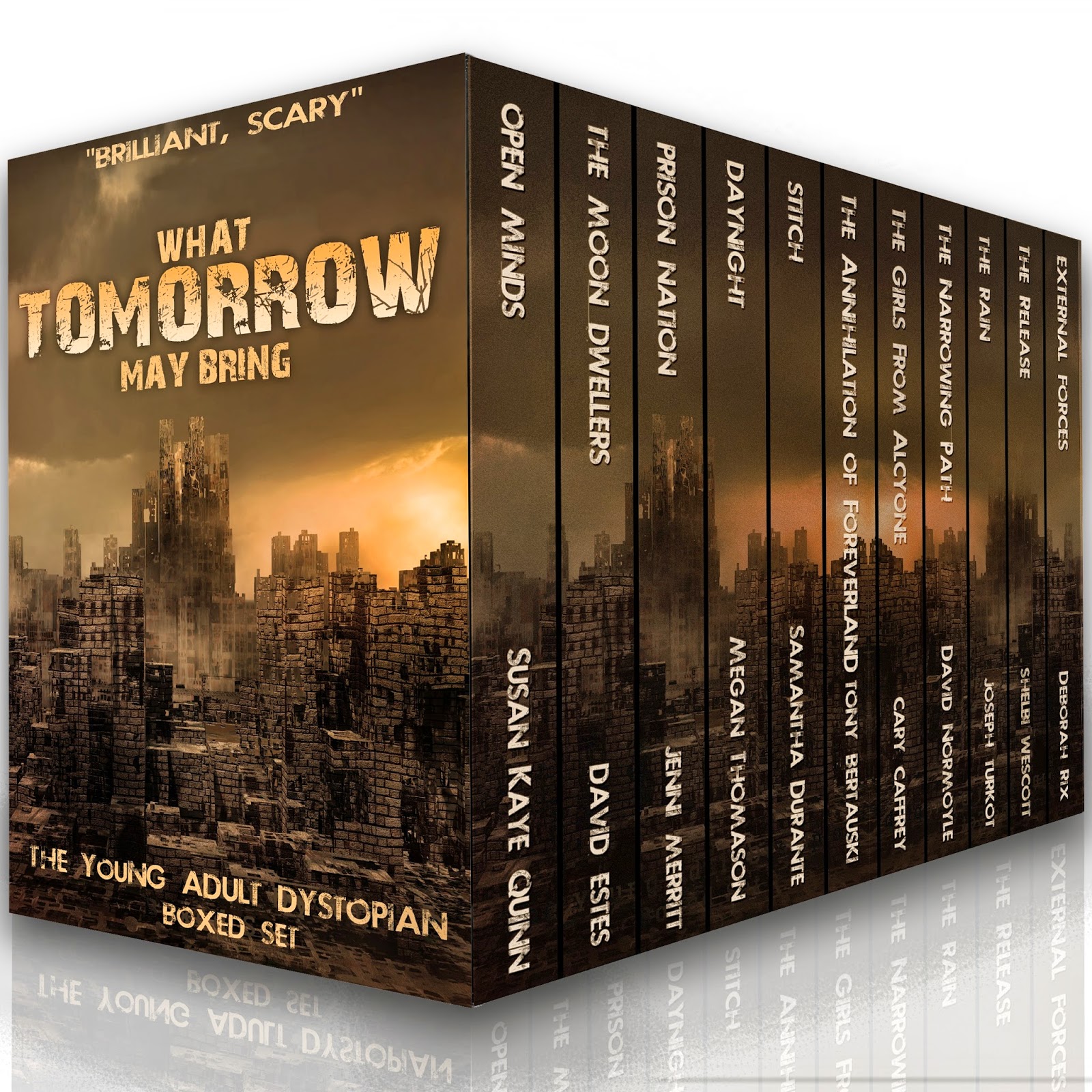
What Tomorrow May Bring

Friday, May 30, 2014

Samantha Durante


I’ve always been drawn to dystopian settings. Not surprisingly, The Giver, Brave New World, and Fahrenheit 451 were some of my favorite books as a kid. But there’s one thing about my beloved dystopian books which has always driven me nuts, and it’s this: no one ever explains how the world came about.

You know what I’m talking about. There’s always some vague backstory about a war or a catastrophe a hundred-plus years ago that brought our current world to its knees, and then out of the ashes rose this wonderful new society where everything was neat and tidy and everyone accepted these crazy new rules just as they were.
But how does that really work? At what point in history have we ever seen one civilization transition into the next without some sort of fight? For the sake of enjoying the story, I always swallow this jagged little pill and accept that the society stands, but there’s forever a tiny voice in the back of my head saying, “Wait – how does any of this make sense? Why would these people allow this to happen? Why would they submit themselves to this kind of control when they knew freedom before? And who put these crazy leaders in charge, anyway?”
When I decided to write Stitch, I wanted to do things differently. I wanted to explore a society in transition – not one where the rules were in place, but one where the people in charge were still trying to figure them out. I wanted to try to understand how we could go from the world we live in today to something totally different, and who could have made that happen and, most importantly, why they would go to the trouble. (And I freely admit that it was impossible to address all of these questions in the first book – but this is what a trilogy is for, right?)
In the Stitch Trilogy, the characters are the first generation to rise from the rubble and start fresh in a new society. They’re young – only teenagers when everything happens – and you get to watch from their eyes how our world came tumbling down, to be replaced with something different, something which was shiny on the surface but quickly turned sinister underneath. In fact, for most of the first book – a blend of paranormal romance, new adult contemporary, and of course, dystopian sci-fi – the characters don’t even realize that they’re living in a world where nothing is as it seems. And you’ll be by their side as they uncover the truth and try to figure out what they can do to set things right.
Because, in the end, I think this is really the crux of the whole dystopian genre: when the world ends, and everything is terrible, and you’re forced to do things you don’t even want to think about just to keep on living, what do you have left? Hope. Only hope.
And it’s that inner optimism – the ability to remind ourselves that there’s something out there worth living for even when our world crumbles beyond our wildest nightmares – that best characterizes us as human beings. Dystopian fiction by its very nature asks us how we can solve our collective problems. How would you structure society to make things better? What could you change that would create a different outcome? After all, every dystopia is just a failed utopia – someone’s unsuccessful attempt at making the world a better place.
So with the Stitch trilogy, we’ll get to play “What If?” through the protagonist Alessa’s eyes – to see how she answers these questions, how far she’s willing to go, and what factors will push her to bend her own rules. And as we watch Alessa struggle to find her place in a transitioning society, we get to ask ourselves: what would I do?


$2.99


Get updates on upcoming promotions for
What Tomorrow May Bring

Tuesday, May 27, 2014

Shelbi Wescott


WHAT IS THE FIRST SCIENCE FICTION BOOK YOU REMEMBER READING?
I remember reading The Boy Who Reversed Himself by William Sleator in 1989 during a cross-country road trip. We were driving from Oregon to Illinois and at the beginning of every driving day my mom gave me a new present to unwrap for that leg of the trip. While sitting in the parking lot of a hotel overrun with silverfish bugs in Keystone, South Dakota, I received Sleator’s book and devoured it by the time we arrived in Cedar Rapids.
Fourth dimensions, scary monsters, and something to do with ketchup as the best thing ever? I grew up in science-fiction loving house, but this is the first time I remember thinking of all the possibilities the genre offered—and it was a genuine way to escape the monotony of a drive through the Plains States.
ANY MOVIE, ANY BOOK…WHO IS YOUR FAVORITE ANTAGONIST?
This is such a fascinating question and I’m sorry, I’m so sorry…I can’t limit it to one. So, here are my favorite antagonists, plural:
- Amon Goeth from Schindler’s List: Watching him on screen portrayed by Ralph Fiennes was the first time I had a visceral reaction to a person in a movie. He gave me a stomachache and I had to close my eyes; I was terrified of him, and even more sickened by the fact that he wasn’t an invention—this was a real man, a true monster.
- Dolores Umbridge from Harry Potter: I’m big on justice and the INJUSTICE of her reign at Hogwarts sent me into a rage. I needed her to be a real person somewhere in the world, so I could travel there and punch here in the face.
- Honorable mentions: Johnny from Karate Kid; John Doe from Se7en; Mr. Burns from The Simpsons; Scar from the Lion King; Hans Grubar from Die Hard; Mr. Potter from It’s a Wonderful Life; Annie Wilkes from Misery.
IS THERE AN AUTHOR THAT YOU WOULD REALLY LIKE TO MEET?
I desperately want to have a lunch with Stephen King and Joe Hill. Actually, can it just be the whole family? I want to be invited to their Thanksgiving. Omg, can that happen? Can someone make that happen?
WHERE WERE YOU BORN AND WHERE DO YOU CALL HOME? WHERE WOULD YOU LIKE TO LIVE?
I was born in Portland, Oregon, and that is also where I currently call home. I’ve always had dreams of taking my writing life and heading off to a small, noisy apartment in NYC, but that feels like I’m cheating on my first love. (But I am taking my whole family there this summer…to write…in a noisy apartment on the Upper West Side. Then I get to come home to Oregon. So, it’s the best of both worlds.)
The reality is Portland is a creative town with such amazing talent and a thriving arts community. I’m immensely proud of my city.
DO YOU EVER WRITE IN YOUR PJ’S?
There are people who don’t write in their PJS? Shameful.
WHAT TALENT WOULD YOU MOST LIKE TO HAVE?
I’d always like to be a better writer—I read such talented stories and I’m insanely jealous of their wordsmithing abilities. But beyond that: I was fired by my piano teacher when I was eight or nine. She actually fired me and sat me on the porch to wait for my mom. So, I wish I could play the piano.
WHAT ARE YOUR PET PEEVES?
People who talk during movies; loud eaters; people who are rude to workers in service industries; bad tippers.
IF YOU HAD A SUPER POWER, WHAT WOULD IT BE? AND IF YOU HAD TO GIVE IT UP TO SAVE NEW JERSY, HOW WOULD YOU EXPLAIN TO NEW JERSEY THEY WERE GOING TO DIE?
I want the super power from that TV show “Out of this World”: to stop time by touching my fingers. Just…pause! Unpause. Pause. Unpause. And, I would definitely avoid saying anything to anyone, and just slowly back away pretending like I didn’t understand. “What? New Jersey? Can’t hear you…”
WHY DIDN’T HURLEY LOSE ANY WEIGHT WHILE ON THE ISLAND?
Can we just pretend that this is the only thing that doesn’t make sense about that show? Because I was a LOST devotee (I had a Dharma Initiative party and replaced all the labels on the food with Dharma labels) and it’s too soon to talk about. Too soon.
ABOUT THE BOOK
HOW IMPORTANT ARE NAMES TO YOU IN THIS BOOK. DID YOU CHOOSE THEM BASED ON SOUND OR MEANING?
My names are important because I name characters after my students as classroom management rewards. Is that strange? Like, “Hey. Stop talking during this quiz or I’m finding/replacing your character from this book. Don’t make me erase you.” Works like a charm.
WHERE DID YOUR TOMORROW SPRING FROM? IN OTHER WORDS, HOW DID YOU COME UP WITH THE CRAZY WORLD?
There is a reservoir in Portland that is just open to the elements…recently a man peed in there and they had to drain the whole thing. (ADDENDUM: Last week’s Portland Must Boil Water fiasco because they found e-coli in the water? Same reservoir.) And it’s where a big chunk of Portland’s water comes from…so, this idea stemmed from a single thought, “How easy would it be…if a group was vast enough…to wipe out civilization by targeting water and air with bioterrorism?” From there, I had to invent and discuss the why. Why would someone want to do that? And then I thought of Noah and how the story there is that God wiped out the world to start over because people were awful. So, give someone a God complex, who wants to decide who is worthy to survive, and have him kill off the world? That is how Virulent took shape.
JUST HOW FAR IN THE FUTURE IS YOUR TOMORROW?
Tomorrow. Like…literally tomorrow. Today. Now. My book develops into a dystopian over the story arc. It starts as a post-apocalyptic tale that shows how our world could fall. I wanted it to feel realistic and scary.
DID YOU DO ANY SPECIFIC OR UNUSUAL RESEARCH FOR THIS BOOK?
Over the course of the trilogy, I have had to do some crazy research (firearms, bombs, bioterrorism). I’m on NSA lists. They don’t know what to make of me based on my Internet searches. 
QUOTE A CHARACTER, ANY CHARACTER.
"Roads? Where we’re going, we don’t need roads."
Oh! You mean one of my characters?
Ms. Johnston says, “Hasn’t anyone told you? It’s the assholes who inherit the earth.”
WHO SHOULD NOT READ YOUR BOOK?
People who have rosy outlooks on human behavior in time of crisis. Seriously? You think everyone is going to band together and become instant do-gooders? I love people, but I don’t have a shred of faith in human nature when SHTF.
ARE ANY OF THE MAIN CHARACTERS FROM THE LGBT (LESBIAN, GAY, BISEXUAL, AND TRANSGENDER) COMMUNITY.
Absolutely. Actually, I got a one-star review because a reviewer didn’t want her pre-teen daughter reading about a woman who had a wife. [Insert eye-roll here] I like to wear that review like a badge of honor. So…we could add that into the “people who shouldn’t read my book” answer, too. If reading about humans bothers you…don’t read this book.
GIVE YOUR BOOK THE BECHDEL TEST
1. IT HAS TO HAVE AT LEAST TWO (NAMED) WOMEN IN IT
2. WHO TALK TO EACH OTHER
3. ABOUT SOMETHING BESIDES A MAN
My books (especially the trilogy as a whole) passes the Bechdel Test with flying colors. But I personally think the test should be harder to pass…let’s raise the bar!
WHAT SORT OF BODY COUNT ARE WE TALKING HERE?
Oh, wow. Yeah. Um. Seven billion people…
Thanks everyone!! Check out the boxed set and the other author Q&As.

$2.99


Get updates on upcoming promotions for
What Tomorrow May Bring

Friday, May 23, 2014

Megan Thomason


I'm a huge fan of the dystopian genre and love to spend a lot of time thinking about societal extremes. The themes indaynight, many of which are very dark, are all designed to have readers think about parallels to our own society and where we need to draw lines.
The dystopia category is pretty broad these days. By definition a dystopian world must have  deprivation,oppression, or terror. I prefer dystopias that explore interesting societal and moral dilemmas to catastrophic conditions/survival stories.
The very best dystopias most often have a well formed government enforcing extremes. I’m fascinated by these entities, and in particular:
- What events drove them to shift the way they governed? For example, in The Hunger Games the government instituted the games to punish and remind the districts of their former rebellion (and failure to succeed).
Hunger Games
- What results are they looking to achieve? In 1984, the desired result was control over every action and thought. In Brave New World the government desired peaceful coexistence and happiness for its citizens.
1984
- What methods do the governments use to achieve the desired result? The Capital in Hunger Games uses the games to terrorize its citizens into subservience, and tightly controls resources by segregating districts and limiting what each could produce. In 1984 the Inner Party uses surveillance (telescreens, microphones everywhere), controls information (rewriting history to support claims is the ultimate form of censorship), and all citizens are indoctrinated to be whistle-blowers on those committing ‘thought crimes’ (any thought contrary to the governmen). In Brave New World, the government breeds and then conditions (through their sleep) citizens to be in (and only desire to be in) a certain caste, to be sexually promiscuous, hate solitude, and to take the drug ‘soma’ if any contrary thought occurs.
1984 v Brave New World
Equally interesting is how the characters in the novel react to the dystopian government. Do they acquiesce? Do they rebel and in what ways? Outwardly? Inwardly? Each well done dystopia will have characters that question the status quo. Their actions will cause us to reflect upon our own, and how we would act in a similar situation. Katniss in The Hunger Games defies authority by bringing out a handful of berries and threatening to deprive the Capital of a winner and ultimately forcing them to back down and lose face. Winston and Julia in 1984 both commit thought crimes and engage in an illicit affair, but are outed by an informant and tortured into both subservience to Big Brother and betraying each other. John (the Savage) in Brave New World is so disgusted when he caves to societal immorality that he takes extreme measures to escape.
daynight came about as I hiked the canyons of San Diego on a particularly hot day and pondered what would happen if temperatures were so extreme that days and nights had to be switched. This became the impetus for Thera, the main setting for daynight. I mentally brewed the concepts of dark and light, and what kind of government would rule the dark, and The Second Chance Institute (SCI) was born.


$2.99


Get updates on upcoming promotions for
What Tomorrow May Bring

Wednesday, May 21, 2014

Joseph A. Turkot


HAVE YOU WRITTEN IN ANY OTHER GENRES BESIDES YA DYSTOPIAN? WHAT DREW YOU TO THIS GENRE?
I started in fantasy, rather epic, Shakespearean fantasy: Darkin. The sequel, Darkin 2, was toned down (as far as its Shakespearean-sounding language), but still retained some of it. It definitely became more readable. After the second book, I moved into horror for a brief spell, writing a couple short stories. From there, I jumped again, publishing a serial novel called Black Hull. This was a fun ride through time and space for me, and a chance to work on terse language. Something I wanted to get good at. Some say I did this too well, and they wanted more description. In either case, I jumped again, going into writing a YA mystery novel called Neighborhood Watch about a serial murderer. This was a blast to write. I felt like I was reliving parts of my own childhood because the setting was so similar. And then, yes, finally, I arrived at the post-apocalyptic, or dystopian world of The Rain. I’ve always been attracted to dystopian literature, maybe because I see so much of the real world in there. It’s not all far-fetched and impossible to me. Okay, maybe The Rain is. But some of the stuff, like 1984, or Oryx and Crake, seem pretty possible. And so I see the cautionary tale thing writ in all its glory within the framework of those stories. And although the setting in The Rain is maybe not as believable in my story, it still provides a place for the characters to think about some aspects of humanity that might otherwise be overlooked or seen as ordinary. I’m all about examining beliefs with an open, malleable mind.

DO YOU HAVE AN INTOXICANT OF PREFERENCE FOR THOSE TIMES WHEN YOU ARE WRITING?

It used to be coffee. And it still is–kinda. I have been mixing in tea. I know, this isn’t very exciting. Sometimes I’ll have several cups of coffee in the same day. But I’m supposed to cut back, so, yeah. That’s the tea. Black, and sometimes Green. Also, running. It acts as an opiate to my mind. Really. I get a lot of thinking done during my runs.
IF YOU GAVE ONE OF YOUR CHARACTERS AN OPPORTUNITY TO SPEAK FOR THEMSELVES, WHAT WOULD THEY SAY?
Get us the hell of this ice. Put us some place warm and dry. Stop having fun with us. No, in all seriousness, it depends on which story we’re talking about. If I chose Colin from Neighborhood Watch, he’d tell me it’s time to hit the streets. Pump some air into your tires, grease the chain, and ride through the fall leaves. Smell that air and see those pumpkins.
DID YOU DO ANY SPECIFIC OR UNUSUAL RESEARCH FOR THIS BOOK?
I like to incorporate wacky scientific facts into my book. Well, maybe they’re not so wacky. One of my favorites, from Black Hull, is the M-82 anomaly. That is pretty much the basis for the Utopia of that book. And as far as The Rain, it’s usually just looking up something like the way a waterspout looks, or confirming something I’ve read in the past about exposure. One area I love, but am lacking in still to this day, is seafaring terminology. I’d love to know more, and incorporate more. I didn’t know, for instance, that I couldn’t use rowing when it concerned a canoe. I honestly never knew that. He said it had to be paddling. I don’t know if I managed to go back and fix that yet. But now it’s in my head–rowing for boats, paddling for canoes. Little things build up in my brain. Most of them useless. Sometimes, crucial to the plot. I try to double-check those ones.
WHAT BOOKS HAVE INFLUENCED YOUR WRITING?
Wow. This is like the impossible question. I mean, I’ve read a lot of books, and they all sort of blend together now. Just a big pile of plot, character, conflict, and setting, all congealing in my imagination forever. But honestly, I can think of it in time. That makes it easier for me to answer this. In the beginning, there were the Goosebumps books. This was the first series I absolutely fell in love with. Like, cherished the covers and everything. Smelled the pages. Later on, as I got older, I got into the science-fiction and fantasy stuff. You know–Lord of the Rings and all that. Still, on the side, because of high school mostly, I was exposed to Steinbeck and Orwell and Hesse and some others. Good old literary fiction. And lately, it’s all about non-fiction. This is the way it’s gone for me for the past few years. It started with The Perfect Storm and Into Thin Air, and then, I’ve been tracking down new adventure survival stories ever since. It’s no wonder my current series is a combination of a post-apocalyptic, dystopian Earth and a survival adventure.
ANY MOVIE, ANY BOOK…WHO IS YOUR FAVORITE PROTAGONIST?
Man. Another impossible question. I mean, who has favorites anyway? Aren’t they supposed to change as we do? But, just for the heck of it, I’m going to go with Alan Grant. He was my biggest hero from about age 8 until about age 12. Seriously, who else knew that much about dinosaurs? And dinosaurs, that’s about the most important thing to know something about. So he was tops. Not to mention how he handled himself when they wanted to kill him and everyone around him. So suave. And the outfit he wore–so amazing. But again, the list of heroes would be long.
IS THERE AN AUTHOR THAT YOU WOULD REALLY LIKE TO MEET?
There have been many. I think right now, who it would be, I have to pick Hugh Howey. He’s been a real inspiration to me, mainly from his forum posts. He’s really encouraging. The stuff he says makes you think you can do it. Anyone can do it. He’s not spewing mindless enthusiasm, it’s actually all concrete and meaningful. So yeah, I’d really like to have a cup of coffee with the guy. Talk about his days at the bookstore.
WHAT ARE YOUR PET PEEVES?
People who are not open-minded. They have a completely closed belief system, and you can’t do a thing about it. I for one will change my mind if the evidence shows up to change my mind. I’m not going to stick to an outdated belief because it feels better, or sits right, or is more comfortable. So there you have it. I’m pretty open to anything. In fact, the principles I cherish most might be open-mindedness and willingness. When someone has the willingness to learn something new, try something new, be open to the possibility even, of some kind of change, that really turns me on. Not sexually of course, but intellectually. I am a philosophical kind of guy, deep down, but there aren’t too many people you can really talk about that kind of stuff with.
$2.99


Get updates on upcoming promotions for
What Tomorrow May Bring